Historic Sibley Missouri

Sibley's History Online

Category: Local History (page 1 of 2)

Area Teachers Learn to Incorporate Archaeology into the Classroom

Jackson County Parks + Rec, the Truman Library and the Atkins-Johnson Farm & Museum offered a class for Teachers, Interpreters & Museum Docents to learn how to incorporate Archaeology into the classroom.

During this workshop, participants investigated a historic farmstead that was found in southwest Montana in 1869. Using data from an actual excavation at the Tinsley Farmhouse, participants learned how archaeologists study the past. Studies of such farmsteads and farm residences are appropriate in Missouri since many similar sites are found throughout the state. Indeed, the Tinsley family ended up in Montana because they fled the bloodshed in Missouri during the Civil War.

The workshop also participated in activities at Fort Osage National Historic Landmark, the Truman Library and engaged in two days of archaeological fieldwork at the Atkins-Johnson Farm & Museum. Participants also had the opportunity to receive two graduate credit hours from Lindenwood University.

CLICK HERE for a full article from KSHB-TV on the archaeological fieldwork at the Atkins-Johnson Farm & Museum.

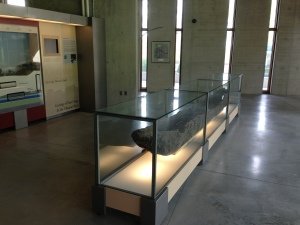
Wood Preservation of the Fort Osage Dugout Canoe

The Fort Osage Dugout Canoe in the Education Center.

The Fort Osage Dugout Canoe in the Education Center.

In early 1992, Dennis Reed, a contract truck driver working on the Big Blue River channelization project near Truman Road, contacted Jackson County Parks and Recreation and indicated that he had retrieved what he believed to be a dugout canoe from a debris pile. He offered to donate the canoe to the Park Department. An inspection by staff indicated that the object was, in fact, a dugout canoe consistent with the type and construction common to Western Missouri. Further inspection indicated that iron tools were probably used in the shaping of the canoe.

The canoe was a basic form of transportation and was common to both the Native American and early European frontiersmen engaged in the fur trade. In consideration of the importance of the fur trade to the mission of Fort Osage it was decided that the canoe would be a significant contribution to the interpretive displays at the fort.

Research indicates that wood objects, which have been water, immersed for extended periods will rapidly disintegrate when exposed to air. Of the major excepted forms of wood preservation, the polyethylene glycol was chosen for this project. The object to be preserved is totally immersed in a solution of polyethylene glycol (peg), which is kept at a constant temperature and gradually increased in concentration. The peg gradually permeates the entire object and displaces the absorbed water in the wood cell structure. After immersion, the object is removed from the solution and a gradual dry out is undertaken to bring the object back to the ambient humidity.

Since the canoe had been already exposed to air for several weeks before it was donated to the County, the first step in conservation was to re-immerse the canoe to prevent further deterioration. After transport to the Fort, the canoe was immersed in a water solution in a temporary tank made of wood and a plastic liner. This suspended further damage, and allowed the staff to formulate a plan of preservation. Various agencies and individuals who had previous experience in wood preservation were contacted. Among those were the Smithsonian, National Park Service, Missouri Department of Natural Resources and the Maryland Department of Natural Resources.

The restoration plan included:

  1. The canoe was subjected to clean water “flush”; a constant flow of clean water removed as much sediment as possible.
  2. The canoe was shown during the 1993 Kansas City Boat Show at Bartle Hall. This was the last public showing of the canoe until the preservation process was completed. The Kansas City Boat Show Company provided the initial supply of polyethylene glycol.
  3. The canoe was then submerged in a new tank with a 5% solution of peg. Electric heaters maintained the solution temperature at approximately 100 degrees Fahrenheit and circulation pumps maintained solution movement. Additional peg was added on a set schedule over an extended period until the solution was at 50%.
  4. The canoe was removed from the solution and an enclosure was constructed around the canoe to retard rapid dehydration. Temperature and humidity gauges were monitored.

The canoe is on permanent display in the Education Center at Fort Osage National Historic Landmark.

Technical Data of the Fort Osage Dugout Canoe:

Found: On the Big Blue River in the Armco Steel Complex
Age: Most likely 200 years…. earliest possible date 1690
Material: Black Walnut
Length: 16 feet, 6.5 inches
Estimated freight capacity: Approximately one ton
Origin: Believed to be Euro-American
Method of Construction: Evidence shows use of iron tools

The following individuals and organizations contributed to the restoration project:

The Native Sons of Kansas City

Dennis Reed

Smithsonian Institute

Kansas City Boat Show

Company Growth Industries

Friends of Fort Osage

Hinckley & Schmitt

Missouri Free Trappers

National Park Service

Missouri Department of Natural Resources

Wyandotte County Museum

Leavenworth Museums

The Arabia Museum

Maryland Department of Natural Resources

Union Carbide and Borax Corp.

Mississippi Department of Archives and History
1864: The Year of Decision?

Coming up on Thursday, December 4, 2014 at 6:30pm, the Kansas City Public Library’s Central Branch will host a panel discussing the events that took place in 1864 during the Civil War. Military historian Ethan S. Rafuse will lead a panel of colleagues with the U.S. Army Command and General Staff College at Fort Leavenworth.

CLICK HERE for more information on the event and to RSVP

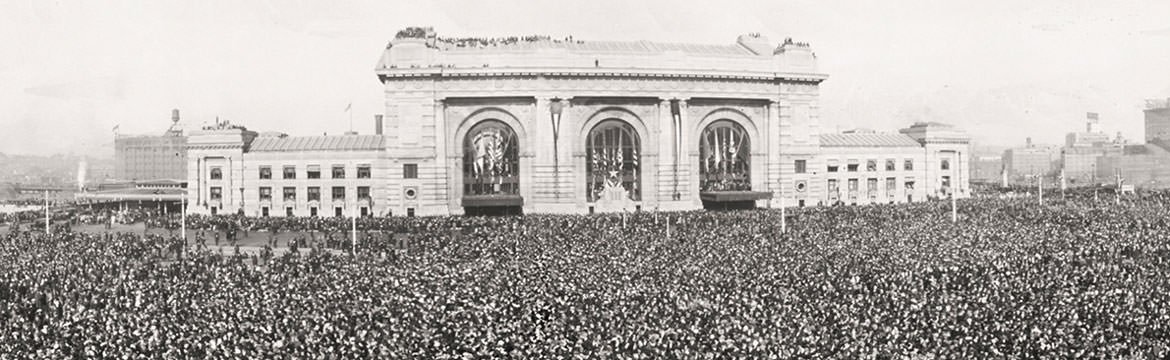
Kansas City’s Union Station Celebrating Its Centennial

Union Station in Kansas City, Missouri. Image Credit: unionstation.org

This week Union Station in Kansas City, Missouri will be celebrating its Centennial. Union Station first opened on October 30, 1914. Union Station made national headlines on June 17, 1933, when four unarmed FBI agents were gunned down by members of a gang trying to free Frank Nash. This became known as the “Kansas City Massacre” and this resulted in the FBI arming all agents. By 1973, Union Station had only six passenger trains a day passing through and the station quickly deteriorated.

In 1996 five counties in both Kansas and Missouri approved 1/8 cent sales tax to renovate Union Station. Today Union Station houses an Amtrak station, a large interactive science museum, rail exhibit, Irish museum, five-story Regnier Extreme Screen theater and Gottlieb Planetarium, the Block theater, as well as restaurants, shops and event spaces.

CLICK HERE for a complete history of Union Station.

CLICK HERE for more information on the Union Station Centennial celebration and other events and exhibits at Union Station.

Missouri Town 1855’s Fall Festival and 50th Anniversary

Missouri Town 1855 Fall Festival of Arts & Crafts. Photo Credit: Jackson County, Missouri

Missouri Town 1855 will be having their annual Fall Festival of Arts, Crafts and Music on October 4th and 5th. You can enjoy 1850’s music and dance, horse-drawn buggy rides, hot-spiced cider, children’s games, period arts and crafts and fun-filled hay rides at the Fall Festival. This year Missouri Town will also be honoring the 50th Anniversary of the village.

Missouri Town 1855 was never a real village in which real people lived and worked. Instead, it is a reconstruction of what a person may have found at a Missouri crossroads during the mid-19th Century. The buildings in the village were moved to Missouri Town 1855 from other locations in seven different western Missouri counties. These are actual buildings from the mid-19th Century. The year 1855 was chosen to interpret because it was the last year before the Kansas-Missouri border fighting began to disrupt the area. By 1856, shootings, lynchings and other violence had polarized pro-slavery and anti-slavery adherents into open conflict.

The festival will be open on Saturday, from 10:00 a.m. - 5:00 p.m. and Sunday, 11:00 a.m. - 5:00 p.m.
Admission for the festival is $10.00 per car/van or $20.00 per school/commercial bus. For more information on Missouri Town 1855 please visit their website at www.jacksongov.org/missouritown or you can call them at (816) 524-8770.

Grand Festival of Chez les Canses at Fort Osage

Grand Festival of Chez les Canses

Explore how early French settlers lived at the confluence of the Missouri and Kansas Rivers in the late 1700s. Re-enactors at Fort Osage, will interpret everyday life skills common on the frontier. Artisans will display custom-made objects, both decorative and utilitarian, which were essential to these early settlers.

This annual event will be held on Saturday, September 27th from 9:00 a.m. - 4:30 p.m.
For more information please contact Fort Osage by phone: (816) 650-3278 ext.1 or visit their website: www.makeyourdayhere.com/fortosage.

An invitation from King George II for the Grand Festival of Chez les Canses.

A invitation from King George II for the Grand Festival of Chez les Canses.

An invitation in French from King Louis XV for the Grand Festival of Chez les Canses.

A invitation in French from King Louis XV for the Grand Festival of Chez les Canses.

Battle of Lone Jack Candlelight Tour

The annual Battle of Lone Jack candlelight tour is coming up on August 16th, 2014. Tickets are $5 a person and can be purchased in advance or on the day of the event at the Battle of Lone Jack Museum. The candlelight tour will begin at 8:30 p.m. on August 16th.

More information can be found at www.historiclonejack.org or on the flyer posted below.

World War I Museum and Google Team Up For Online Exhibit

The National World War I Museum and Google are teaming up to bring visitors an online interactive exhibit on World War I. The exhibit is called “Home Before the Leaves Fall”, it examines the beginning of the first World War with audio and visual materials from the museum’s collection.

CLICK HERE to access the online exhibit from the Google Cultural Institute.

CLICK HERE for the complete article from the Kansas City Star.

CLICK HERE for more information on the National World War I Museum.

A Brief History Of Memorial Day

A marker remembering the soldiers who died at Fort Osage.  Photo taken Memorial Day 2013

A marker in the Sibley Cemetery remembering the soldiers who died at Fort Osage.
Photo taken Memorial Day 2013

The beginnings of Memorial Day dates back to the Civil War. On May 5, 1868, the head of the Grand Army of the Republic (GAR) established Decoration Day as a time to decorate the graves of soldiers who died during War. Decoration day was then moved to May 30th, as it was believed that flowers all over the United States.

Grave of William Ernest Long. World War I Veteran.

Grave of William Ernest Long
World War I Veteran.
Photo taken Memorial Day 2014.

After World War One Memorial day was expanded to include those who died in every American War and not just the Civil War.

Congress made Memorial Day a Federal Holiday in 1971. Also in 1971, Memorial Day was moved from May 30th to the last Monday in May to align with other Federal Holidays.

All Americans are encouraged to pause for a minute of silence at 3 p.m. local time on Memorial Day to remember those who have died while serving our country.

CLICK HERE for a complete history on Memorial Day.

The Wayne City Landing

Sugar Creek will be commemorating the Wayne City Landing with a new festival later this summer. The “Wayne City Landing Days” will be held August 7-9 in Sugar Creek.

The Wayne City Landing connected the Independence Square with the Missouri River. It was a popular place where travelers would obtain provisions before embarking on the Santa Fe, Oregon or California trails.

CLICK HERE for a full article from the Jackson County Historical Society.

Older posts